Calvin Ludwig didn’t set out to start a drone business.
He was deep into his career as a project manager in construction—juggling timelines, coordinating subcontractors, and constantly chasing better ways to document project progress.
Then came a gift: a drone for Christmas.
What began as a fun hobby quickly became something more. Calvin brought the drone to a job site, took a few aerial shots, and included them in the company’s monthly project report.
The reaction?
“The company went ballistic,” he says. “They were like, ‘This is amazing—can you shoot our other projects too?’”

That’s when the lightbulb went off. If his employer saw that much value in quality aerial documentation, maybe others would too.
Once he realized flying drones could be more than a hobby, Calvin got his Part 107 license—something every commercial drone pilot is required to have. To help him prepare for the Part 107 test, Calvin studied using Drone Pilot Ground School, and passed on his first attempt.
After securing his drone license, Calvin began offering drone services to construction companies as a freelancer. Eventually, that work led him to start 4Blades Digital—a drone services company built from the ground up to serve the unique needs of the construction industry.
Today he makes over a quarter million a year. And he just made his first full-time hire.
Keep reading to learn how Calvin built his successful construction drone services business from the ground up.
Built for Construction: Solving Problems on Site and in the Office
Before launching 4Blades Digital, Calvin Ludwig spent a decade managing construction projects. He wasn’t a casual observer. He was in the trenches—overseeing schedules, coordinating subcontractors, and dealing with the constant unpredictability of job sites.
That background in construction didn’t just shape his business. It is his business.
“I didn’t set up 4Blades as a photography company,” Calvin says. “I set it up as a subcontractor in construction. I run it like an electrical or concrete company—like a trade partner.”
That framing matters.
Most drone operators pitch construction companies with real estate photos or fly-by marketing content—pitches that show they don’t understand the needs of the client.
Instead, Calvin delivers what construction companies actually need: accurate, timely, and construction-literate documentation. He knows what to shoot, when to show up, and how to integrate smoothly into fast-moving construction schedules.
“If you need final shots before tenants move into an apartment building, your window for getting them may be very small. I get this, and I show up right when you need and get you exactly what you need.”
This responsiveness has become a core value for 4Blades. But Calvin’s success isn’t just about being available and punctual—it’s about understanding what matters on site.
That means understanding the specific details of what needs to be photographed and videoed, including things like:
- Capturing slab penetrations before concrete is poured
- Tracking logistics with overhead imagery
- Documenting environmental conditions to accurately track and document weather delays
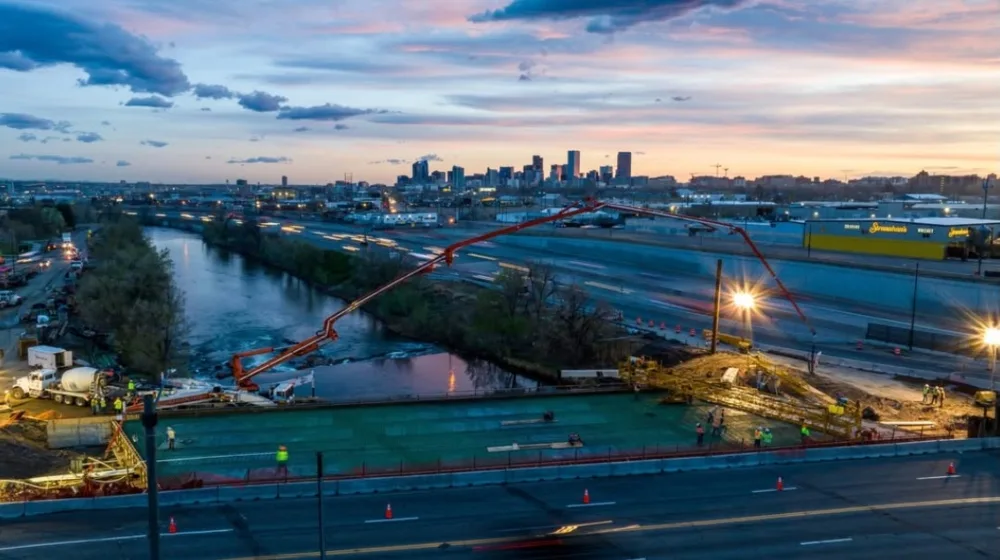
It also means making the site look good for marketing materials.
That’s because Calvin’s drone flights serve more than just field teams. Every mission he flies produces dual-value content: technical documentation for construction crews, and polished visuals for marketing teams.
“I spent years sitting next to marketing folks who were always complaining, ‘I never have good photos!’” Calvin says. “Now I give them a package they can use to showcase a property—without them even needing to ask.”
Here’s what a typical deliverable from 4Blades might include:
- Orthomosaic maps for surveying and QA
- Aerial 360s for jobsite records and executive updates
- Overhead shots for site logistics planning
- Progress documentation, week to week
- Pre-pour and post-pour visuals of key milestones
- Photo and video content for social media and business development
One flight. Two departments served.
That kind of efficiency—combined with deep industry understanding—is one of the reasons Calvin has become the go-to drone partner for many construction companies across Denver.
Making the Leap: From Side Hustle to Full Time
Calvin has built 4Blades into a thriving business. But at some point he had to quit his full time job and go all in to make that happen.
So how did he know when to quit?
It didn’t happen overnight. For five years, Calvin ran 4Blades while working full time as a project manager.
During that time, he balanced a demanding job in construction management with the growing responsibilities of running his own business. It meant long hours, early mornings, and late nights. And it was hard work.
“I’d wake up at 4 A.M., shoot a site at golden hour, work a full day in the office, then go home and edit photos until midnight,” he says. “Then do it all again the next day.”
At one point, he even switched to a slightly more laid-back construction company—not because he wanted a lighter workload, but because he needed more flexibility to keep growing his business. He was transparent during the interview process, telling them up front that he had a business on the side.
To his relief, they were supportive. That job gave him just enough breathing room to juggle both roles.
Over time, it became clear that something had to give. Despite pouring everything into 4Blades, he just didn’t have enough time to make the company as successful as he knew it could be.
“For the first five years, I was doubling, tripling, sometimes even quadrupling my revenue year over year,” he says. “But then I hit a wall. I was too busy with my day job to take on more work or invest in business development. If I didn’t go full time, the company wasn’t going to keep growing.”
So he set a goal: make as much from 4Blades as he did in his day job—around $5,000–6,000/month.
Once he hit that threshold, he quit.
“And right after that, the business exploded. That year, I quadrupled revenue again.”
Last year, 4Blades brought in over a quarter million dollars. Calvin now consistently earns $20-$30K a month—significantly more than he did as a project manager.

The State of the Business Today
4Blades Digital isn’t just a drone services company—it’s a visual operations partner for the construction industry. And it’s built for scale.
Calvin’s gear stack reflects that level of professionalism and readiness.
His fleet includes:
- Mavic 4 Pro
- Mavic 3 Pro Cine—his go-to for daily site work
- Mavic 3 Cine—now flown by his employee
- Mavic 3 Enterprise—deployed specifically for orthographic mapping and aerial surveying
- DJI Avata + custom FPV rig—for immersive interior walkthroughs and special projects
On the ground, he’s running a Sony FX3 and an a7R IV for handheld documentation, paired with a DJI Ronin for stabilization.
Editing and post-processing happen in the Adobe Suite—Lightroom, Photoshop, Premiere—and for mapping, he uses SiteScan, a platform similar to DroneDeploy that integrates seamlessly with his construction workflows.
In terms of deliverables, 4Blades provides a range of highly specialized products:
- Orthomosaics and aerial surveys
- Aerial 360s for site visualization and historical documentation
- Marketing photo/video packages for developers
- Progress documentation tailored for field teams
- Pre-construction and post-construction environmental scans
- Visual records for permitting, litigation protection, and city compliance
And now Calvin’s not doing it all alone. In a major milestone, he recently hired his first full-time employee—a friend he mentored, trained, and eventually equipped with a Mavic 3 Cine.
“It wasn’t just about needing help,” Calvin says. “It was about freeing myself up to grow the business, to step back and know it could keep running even if I took a vacation.”
The new hire is currently working toward his Part 107 certification using Drone Pilot Ground School—the same program Calvin used when he was getting started.. He’ll soon start flying under Calvin’s supervision as a Remote Pilot in Command.
The numbers speak for themselves. For the past two years 4Blades has brought in over a quarter million in annual revenue.
And with the new hire and more demand than he can handle solo, the business is only picking up speed.

Calvin’s Advice: Find a Real Problem and Solve It
If there’s one thing Calvin Ludwig wants aspiring drone pilots to understand, it’s this:
The drone isn’t the product. The problem you solve is.
“I don’t succeed because I fly drones,” he says. “I succeed because I understand construction.”
Here’s some advice he shared with us for those looking to start their own drone business:
1. Start With What You Know
Start with what you already know. Don’t try to force a fit—find one.
That mindset is at the heart of everything Calvin teaches others who are looking to break into the industry.
“If someone works in logistics or trucking or agriculture, there are drone use cases in those industries. I don’t know what they are—but they probably exist,” he says. “And that’s where you should start.”
In other words, your best business idea may be hiding inside the day job you’re trying to leave.
That’s how it worked for Calvin. He took the pain points he experienced firsthand as a project manager—poor site documentation, last-minute marketing requests, lack of visual records—and built a business around solving them.
2. Be Fast and Reliable—And Charge Appropriately
And once you do find your niche?
Deliver fast. Deliver well. And charge accordingly.
“I don’t compete on price,” Calvin says. “I compete on speed and quality. If someone needs a site documented that day, I can do it—and they’ll pay for that.”
That emphasis on responsiveness has helped Calvin earn a reputation as the go-to drone partner in Denver construction. When the sidewalk needs to be documented before it gets ripped up, when the weather shuts a job site down and you need evidence to explain work delays—Calvin is the guy who shows up.
“There’s not a lot of people doing what I do, how I do it,” he says. “This industry is starving for people who can solve real problems.”
[Read our guide, Drone Services Pricing: A Guide to Pricing Your Drone Work]
3. Be the Expert
This is another key point Calvin stresses: drone pilots often show up asking, “What can I do for you?”
Instead, you should flip that.
“Don’t show up on a job site empty-handed,” he says. “Come in and say, ‘I know you have this problem—and I can solve it.’ That’s how you get work, and it’s also how you build trust.”
4. Build Word-of-Mouth Referrals
Calvin’s never had to spend money on advertising. His business has grown through word of mouth and reputation—because when clients call, he answers. When they need something last-minute, he gets it done.
And in construction, that kind of reliability isn’t just appreciated. It’s rare.
And Calvin’s story proves it works. By leaning into his industry knowledge, staying relentlessly responsive, and building trust over time, he didn’t just carve out a niche—he built a thriving business.
This advice isn’t theoretical. It’s the blueprint Calvin used to go from early morning flights and late-night edits to running one of Denver’s most respected construction drone operations.
Want to build your own drone business like Calvin? It all starts with getting certified. Enroll in Drone Pilot Ground School and start your journey today.