Type: Fixed-Wing VTOL Drone
The JOUAV CW-25E is a high-performance fixed-wing VTOL drone designed for long-range, large-scale missions.
Its aerodynamic design and long endurance make it a favorite for applications requiring detailed mapping and monitoring over vast areas. With robust payload options and precision navigation capabilities, this drone is tailored for professional use in industries like infrastructure inspection and environmental conservation.
Top Use Cases:
- Pipeline and powerline monitoring
- Forestry and land management
- Topographic mapping
- Coastal and wetland surveys
Key Specs:
- Flight time. Up to 8 hours
- Payload capacity. Up to 3 kg
- Camera options. Thermal, LIDAR, and high-resolution RGB cameras
- Range. Up to 200 km (124 miles)
The Basics of VTOL Drone Design
VTOL drones is a type of UAV engineered to combine the vertical takeoff and hovering capabilities of multi-rotor drones with the range and efficiency of fixed-wing aircraft.
That means they excel in operations that require both vertical and horizontal flight capabilities.
To put this another way, while other types of drones are limited to only hovering or long-range flight, VTOL drones can transition between the two modes, making them useful for a range of applications.
This unique design enables them to operate in confined spaces—where they can safely take off and land—while maintaining the ability to cover large distances, making them ideal for a variety of applications such as:
- Mapping
- Surveillance
- Delivery
Core Elements of VTOL Drone Design
The core components of a VTOL drone include:
- The propulsion system
- The wings
- The rotors
These elements work together to allow the drone to transition seamlessly between vertical and horizontal flight modes.
Multi-rotor configurations enable vertical lift, while fixed wings provide the aerodynamic efficiency needed for sustained forward flight. And some newer designs incorporate tilting rotors or separate propulsion systems for takeoff and cruising.
How VTOL Drones Combine the Best of Fixed-Wing and Multi-Rotor Designs
One of the standout features of VTOL drones is their ability to leverage the strengths of both fixed-wing and multi-rotor designs.
- Fixed-wing drones are known for their long flight times and energy efficiency, making them ideal for large-scale operations. However, they require runways or launch systems for takeoff and landing.
- Multi-rotor drones, on the other hand, can take off and land vertically, but their flight range is limited due to higher energy consumption.
VTOL drones bridge this gap by incorporating design elements from both types.
For example, a VTOL fixed-wing drone might use a multi-rotor system for takeoff and landing, then switch to fixed-wing mode for forward flight.
Hybrid VTOL designs go a step further, integrating tilting rotors or wings that adjust dynamically to optimize flight performance.
Types of VTOL Drones
This chart provides an overview of the three main types of VTOL drone designs.
| Type of VTOL Drone | Key Features | Best Applications |
|---|---|---|
| Fixed-Wing VTOL Drones | Combines fixed-wing efficiency with vertical takeoff; long flight times; extended range. | Environmental monitoring, mapping, surveying, search-and-rescue missions. |
| Hybrid VTOL UAVs | Blends fixed wings and rotors; capable of hovering and long-range flights; versatile for multi-tasking. | Precision agriculture, infrastructure inspection, and defense operations. |
| Multi-Rotor VTOL Drones | Relies on rotors for both takeoff and flight; excellent hovering and stability; short-range operations. | Close-range inspections, photography, public safety applications. |
| Advanced VTOL UAVs | Equipped with AI, thermal imaging, LiDAR, and modular designs; highly adaptable for specialized tasks. | Disaster response, industrial inspections, large-scale surveying, and urban air mobility. |
Now, let’s take a closer look at each one.
Fixed-Wing VTOL Drones

Fixed-wing VTOL drones feature fixed wings for forward flight and separate rotors for vertical takeoff and landing.
They combine the speed and efficiency of traditional fixed-wing aircraft with the ability to take off and land vertically, eliminating the need for runways. This design makes them ideal for long-range missions like mapping, surveying, and environmental monitoring.
Known for:
- Long flight times. Fixed-wing VTOL drones are designed for extended operations, offering significantly longer flight times compared to multi-rotor drones.
- Efficient energy use. Their aerodynamic design minimizes energy consumption, making them highly efficient for large-scale missions.
- Long-range capabilities. Ideal for covering vast distances, they are commonly used in mapping, surveying, and environmental monitoring.
- High payload capacity. Fixed-wing VTOL drones can carry advanced sensors and equipment, such as LIDAR, thermal imaging cameras, and high-resolution mapping tools.
Favored use cases:
- Mapping and surveying. Long-range operations for mapping large areas, such as agricultural fields or forests.
- Environmental monitoring. Tracking wildlife, monitoring deforestation, or assessing climate impacts in remote regions.
- Search and rescue missions. Covering wide search areas efficiently, especially in disaster-stricken regions.
Hybrid VTOL UAVs: A Perfect Balance for Complex Tasks

Hybrid VTOL UAVs blend the best features of fixed-wing and multi-rotor drones, offering versatility for a wide range of applications.
These drones use tilting rotors or wings to transition smoothly between vertical and horizontal flight. This design enables them to provide hovering precision while also covering large distances efficiently.
Known for:
- Versatility in flight modes. Hybrid VTOL drones combine vertical takeoff and landing with efficient horizontal flight, making them suitable for a variety of tasks.
- Precision hovering. Equipped with multiple rotors, hybrid VTOL drones can hover stably, making them ideal for detailed inspections or localized data collection.
- Efficient long-range coverage. Their fixed-wing capabilities enable them to cover large areas quickly and efficiently, reducing operational time and costs.
- Advanced payload integration. These drones can carry various payloads, such as thermal imaging cameras, LIDAR sensors, and multi-spectral cameras, for diverse applications.
Favored use cases:
- Precision agriculture. Monitoring crops, irrigation systems, and soil health with advanced sensors.
- Infrastructure inspection. Inspecting long linear infrastructure like powerlines, pipelines, or railway tracks.
- Defense and security. Conducting reconnaissance missions or perimeter surveillance in dynamic environments.
Multi-Rotor VTOL Drones

Multi-rotor VTOL drones are designed for tasks that demand precise control and stability.
Unlike fixed-wing or hybrid designs, these drones rely entirely on rotors for both vertical and horizontal movement. This makes them ideal for close-range inspections, detailed data collection, and operations that require hovering precision.
Known for:
- Precise control and stability. Multi-rotor VTOL drones rely entirely on rotors for vertical and horizontal movement, offering unmatched precision for close-range tasks.
- Ideal for close-range inspections. These drones are perfect for examining wind turbines, bridges, cell towers, and other infrastructure where stability is essential.
- Ease of deployment. Their compact design and hovering capabilities allow for quick setup and operation, especially in urban or confined environments.
- High maneuverability. These drones can navigate complex environments and hover in place, making them suitable for public safety and emergency response applications.
Favored use cases:
- Close-range inspections. Examining structures like wind turbines, cell towers, and bridges where stability is essential.
- Aerial photography and videography. Capturing high-resolution, stable footage for creative and commercial purposes.
- Public safety. Assisting in firefighting, law enforcement, or emergency response with precise hovering capabilities.
Advanced Applications of VTOL UAVs
As technology continues to evolve, VTOL UAVs are being tailored for specialized tasks in cutting-edge industries.
For instance, drones equipped with thermal imaging and LiDAR sensors are transforming tasks like wildfire monitoring and archaeological surveys. The flexibility of VTOL UAV designs allows them to adapt to unique challenges, demonstrating their value across a growing number of fields.
5 Key Applications for VTOL Drones

1. Agriculture
In agriculture, VTOL drones are revolutionizing the way farmers monitor and manage their crops.
These drones can efficiently cover large areas, providing high-resolution aerial imagery that helps detect issues such as pest infestations, nutrient deficiencies, and water stress. Unlike traditional multi-rotor drones, VTOL drones can perform long-range surveys of expansive fields while still being able to take off and land in confined farm areas.
Common Applications
- Crop health analysis
- Irrigation and water stress monitoring
- Pest and disease detection
- Soil fertility mapping
- Yield prediction and optimization
Example Use Case
A hybrid VTOL drone equipped with multispectral cameras can analyze crop health and provide actionable data to optimize irrigation and fertilization, reducing costs and boosting yields.
2. Public Safety
VTOL drones play a critical role in emergency response and search-and-rescue operations.
Their ability to take off and land vertically allows them to deploy quickly in disaster zones, where space is often limited. Additionally, their capacity for extended flight makes them ideal for covering large areas during search missions.
Common Applications
- Search-and-rescue missions
- Disaster response and assessment
- Firefighting coordination
- Crowd monitoring and management
- Law enforcement surveillance
Example Use Case
A VTOL drone equipped with thermal cameras is deployed to locate missing hikers in a dense forest, reducing the time required for search-and-rescue teams to find and assist them.
3. Environmental Monitoring
VTOL drones are widely used for environmental monitoring, particularly in remote or sensitive ecosystems.
Conservationists deploy these drones to track wildlife, monitor deforestation, and assess the health of wetlands and coastal areas. The combination of vertical takeoff capabilities and long-range flight allows them to access areas that would otherwise be difficult or dangerous to reach.
Common Applications
- Wildlife tracking and conservation
- Deforestation monitoring
- Coastal and wetland health assessments
- Climate change research
- Disaster monitoring and mitigation
Example Use Case
A fixed-wing VTOL drone equipped with LiDAR sensors maps changes in forest canopies, helping researchers study the effects of climate change on biodiversity.
4. Logistics and Delivery
In the logistics industry, VTOL drones are paving the way for faster and more efficient deliveries.
Their ability to operate without the need for runways makes them ideal for reaching remote or hard-to-access locations. Companies are using vertical takeoff drones to transport medical supplies, packages, and critical equipment to areas where traditional delivery methods are impractical.
Common Applications
- Medical supply delivery to remote areas
- Package delivery in urban environments
- Disaster relief logistics
- Critical equipment transportation
- Last-mile delivery solutions
Example Use Case
A VTOL drone delivers lifesaving medications to an isolated village during a flood, significantly reducing delivery times compared to ground-based transport.
5. Infrastructure Inspection
VTOL drones are transforming the way critical infrastructure is inspected.
Utility companies use these drones to monitor powerlines, pipelines, and wind turbines, minimizing the need for manual inspections in hazardous environments. Their ability to hover for close inspections and travel long distances for linear infrastructure makes them uniquely suited for these tasks.
Common Applications
- Powerline inspections
- Pipeline monitoring
- Wind turbine assessments
- Bridge and structural inspections
- Solar panel performance checks
Example Use Case
A VTOL drone equipped with high-resolution and thermal cameras detects potential faults in powerlines, allowing utility companies to address issues proactively and reduce downtime.
Comparing VTOL Drones with Traditional Drones
When is a VTOL drone the right choice? And when should you go with a different type of drone?
We made this comparison table to help you navigate the decision.
| Feature | VTOL Drones | Fixed-Wing Drones | Multi-Rotor Drones |
|---|---|---|---|
| Takeoff and Landing | Vertical, no runway needed | Requires runway or catapult | Vertical, no runway needed |
| Range | Medium to long | Long | Short |
| Flight Time | Moderate to long | Long | Short |
| Payload Capacity | Moderate | High | Low to moderate |
| Hovering Capability | Yes | No | Yes |
| Applications | Surveying, mapping, emergency response | Long-range monitoring, large-scale mapping | Close-range inspections, photography |
VTOL Drones vs. Fixed-Wing Drones
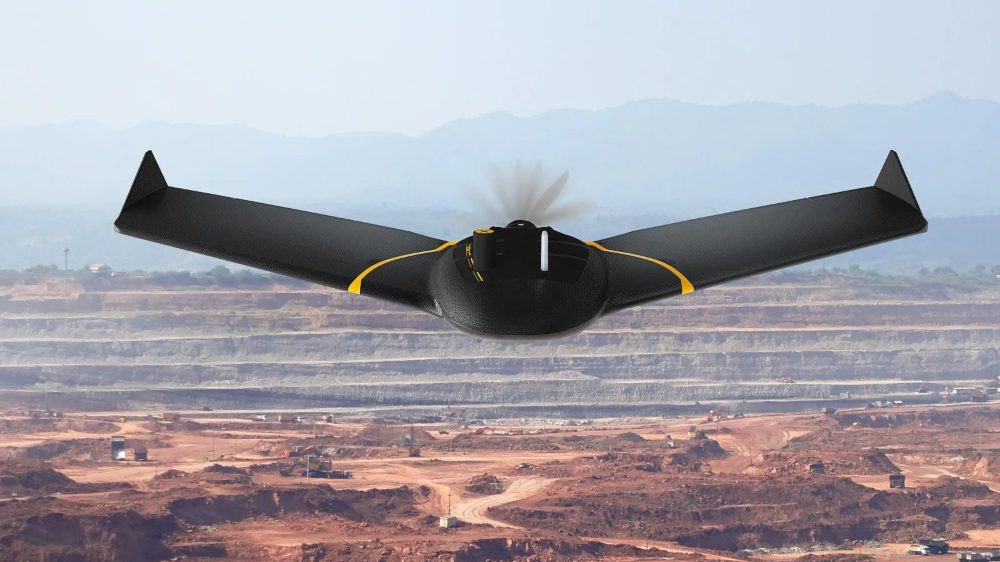
Fixed-wing drones are known for their efficiency in long-range and high-speed operations but require runways or launch systems for takeoff and landing.
VTOL drones eliminate this limitation by combining the vertical takeoff and landing capabilities of multi-rotor drones with the range and efficiency of fixed-wing designs. This makes VTOL drones ideal for scenarios where space is limited but long-range coverage is necessary.
While fixed-wing drones excel in endurance and payload capacity, they lack the hovering ability required for detailed inspections or stationary monitoring. VTOL drones bridge this gap, providing a versatile solution that performs well in both scenarios.
VTOL Drones vs. Multi-Rotor Drones
Multi-rotor drones are highly maneuverable and ideal for tasks that require precision and stability, such as close-range inspections or aerial photography. But their shorter flight times and limited range make them less suitable for large-scale operations.
VTOL drones, on the other hand, offer extended flight capabilities while retaining the ability to hover, making them more versatile for applications like surveying, mapping, and emergency response.
Choosing between a VTOL drone and a multi-rotor drone depends on your specific needs.
If your task requires hovering precision over small areas, a multi-rotor drone may suffice. For missions requiring long-distance travel or hybrid functionality, VTOL drones are often the better choice.
VTOL Drone Kits and Custom Builds
VTOL drone kits are pre-packaged solutions that provide the components needed to assemble a vertical takeoff drone.
These kits are ideal for hobbyists, researchers, and businesses looking to customize drones for specific applications. They often include parts such as frames, motors, wings, propellers, and electronic components, along with detailed instructions for assembly.
Custom VTOL Drone Builds: Pros and Cons
Building a custom VTOL drone from scratch appeals to those who want complete control over the design and features of their drone.
By sourcing individual components, such as propulsion systems, flight controllers, and specialized payloads, users can tailor the drone to their unique needs, whether for research, industrial use, or creative projects.
Advantages:
- Flexibility to incorporate specific features, such as advanced sensors or higher payload capacities.
- Cost savings compared to purchasing a fully assembled professional VTOL drone.
- Opportunity to learn and gain hands-on experience with drone technology.
Challenges:
- Time-consuming assembly and testing process.
- Higher potential for technical issues without manufacturer support.
- Requires a deeper understanding of aerodynamics, electronics, and software integration.
Is a VTOL Drone Kit or Custom Build Right for You?
Choosing between a kit and a custom build depends on your goals and expertise.
For beginners and hobbyists, a VTOL drone kit offers an accessible entry point with fewer technical challenges. Researchers and businesses with specific needs might prefer custom builds for the flexibility they provide in integrating specialized components.
Whether you opt for a pre-assembled kit or a fully custom design, both paths offer exciting opportunities to explore the capabilities of vertical takeoff drones and their applications in various fields.
VTOL Drone FAQ
Here are the answers to the most commonly asked questions about VTOL drones.
What does VTOL stand for?
VTOL stands for Vertical Take-Off and Landing, describing drones or aircraft that can take off, hover, and land vertically without requiring a runway.
What is a VTOL drone?
A VTOL drone is an unmanned aerial vehicle (UAV) that combines the hovering capabilities of multi-rotor drones with the range and efficiency of fixed-wing designs, making it ideal for applications like mapping, inspection, and delivery.
What industries benefit most from VTOL drones?
Industries such as agriculture, logistics, environmental monitoring, infrastructure inspection, and emergency response benefit greatly from VTOL drones due to their versatility and ability to operate in various environments.
How do VTOL drones work?
VTOL drones use vertical lift for takeoff and landing, typically powered by rotors, and transition to horizontal flight using fixed wings for efficient long-distance travel. This hybrid design allows them to perform in confined spaces and cover large areas.
How much does a VTOL drone cost?
VTOL drone costs range from $5,000 for basic models to over $100,000 for advanced commercial-grade drones with specialized payloads like thermal imaging or LIDAR sensors.
How far can a VTOL drone fly?
The flight range of a VTOL drone depends on its specifications but typically ranges from 10 to 100 kilometers. High-end VTOL drones with long flight times and efficient power systems can cover even greater distances.
What are the advantages of VTOL drones compared to traditional drones?
VTOL drones offer the ability to take off and land vertically, eliminating the need for runways, while providing greater range and efficiency than multi-rotor drones. This combination makes them suitable for diverse applications, from precision agriculture to long-range inspections.
Are VTOL drones difficult to operate?
While VTOL drones may have a steeper learning curve compared to standard drones, advancements in automated flight planning and control systems have made them increasingly user-friendly for both beginners and professionals.