Police use drones every day to make their work safer and more efficient.
But this wasn’t the case just a decade ago. Over the last few years, the use of drones in law enforcement has rapidly expanded, aided by improvements in the technology and a growing awareness of all the benefits drones can provide to police work.

Credit: DJI
As drones have become more accessible and affordable, drones for police use have become integral to policing strategies, helping law enforcement agencies tackle challenges that would otherwise require more time, resources, and personnel. Today, drones are being used to support a wide range of police activities, from high-altitude surveillance to rapid response in emergencies to rapid deployment at unfolding crime scenes in DFR programs.
In this guide we’ll cover how police use drones in their work, how to start a police drone program, and some key considerations when looking for a drone for law enforcement.
Here’s everything we cover in case you’d like to jump around:
- How to Start a Police Drone Program: A Step-by-Step Guide
- How Police Use Drones: 10 Key Applications in Law Enforcement
- Top 4 Benefits of Police UAVs
- Types of Drones Used by Police
- Case Studies: 5 Real-Life Cop Drone Stories
- 5 Key Features for Choosing a Police Drone
- Future of Drones in Law Enforcement: 5 Trends and Innovations
- Police UAV FAQ
How to Start a Police Drone Program: A Step-by-Step Guide
Starting a police drone program can greatly enhance a department’s capabilities in surveillance, search and rescue, and other law enforcement tasks.
Police departments can establish a drone program either by operating under the FAA’s Part 107 rules or by applying for a Certificate of Authorization (COA).
[Related read: DJI Alternatives: A Comprehensive Guide for Drone Pilots]
Here’s a detailed, step-by-step guide on starting a police drone program using both pathways.
Starting a Police Drone Program Under The FAA’s Part 107 Rules
Operating under Part 107 rules allows police departments to follow the same regulations as commercial drone operators. This approach is often faster and simpler to set up, though it comes with certain limitations, such as restrictions on night operations or flying over people without waivers.
- Familiarize with Part 107 Requirements
Begin by understanding the FAA’s Part 107 regulations governing drone operations for commercial and governmental purposes. This will provide guidance on allowable operations, including flight altitude limits, line-of-sight requirements, and necessary permissions for specific types of operations. - Ensure Pilot Certification
At least one department member must be certified as a Remote Pilot under Part 107. To do this, the officer must:- Pass the FAA’s Part 107 knowledge test at an FAA-approved testing center.
- Submit an application through the Integrated Airman Certification and Rating Application (IACRA) website to obtain a Remote Pilot Certificate.
- Acquire Necessary Equipment
Select the appropriate drones and accessories based on the department’s operational needs. Consider drones with advanced features, such as high-definition cameras, thermal imaging, and obstacle avoidance systems. - Develop Departmental Policies and Procedures
Establish guidelines for safe and ethical drone operations, including privacy considerations, data storage, and situational use protocols. Define standard operating procedures (SOPs) that cover pre-flight checks, in-flight operations, and post-flight documentation. - Apply for Additional Part 107 Waivers if Needed
For operations not typically allowed under Part 107—such as night flights or flights over people—you’ll need to apply for waivers. Submit waiver requests through the FAA’s DroneZone portal, providing a detailed risk assessment and mitigation plan. - Begin Training Exercises
Conduct training sessions to ensure all team members are familiar with drone operations, flight safety, and emergency procedures. Training should include both simulated and real-life scenarios to build skills and confidence in using the technology.
Starting a Police Drone Program Using a Certificate of Authorization (COA)
A Certificate of Authorization (COA) allows public safety agencies to operate drones for specific, approved purposes, often with fewer restrictions than Part 107. This approach is suitable for departments needing greater operational flexibility, such as flying beyond visual line of sight (BVLOS) or during emergency situations.
- Apply for a Public Safety COA
Start by applying for a public safety COA through the FAA’s FAA Public Safety and Government portal. A COA enables agencies to operate outside some Part 107 limitations, but applications must be specific to the intended use and geographical area. - Complete the FAA COA Process
As part of the application, provide a detailed operational plan, outlining:- Specific locations and airspace where the drone will operate.
- Safety protocols for BVLOS, night operations, and other advanced capabilities.
- Risk mitigation strategies to protect bystanders and property.
The FAA may require additional documentation or approvals for certain types of operations.
- Ensure Pilot and Staff Training
Pilots operating under a COA must be trained in line with the agency’s standards. Training should cover drone operation, airspace awareness, and emergency procedures. Some agencies may require their pilots to have a Part 107 certificate as well, even when flying under a COA. - Establish and Maintain Communication with Local Air Traffic Control (ATC)
For COA operations in controlled airspace, coordinate with local ATC to ensure flight safety. Provide ATC with details of your operating area, emergency contacts, and notification procedures to avoid airspace conflicts. - Define and Document Use Cases and Protocols
Create a clear set of use cases for drone deployment, such as emergency response, crowd monitoring, and accident investigation. Each use case should have corresponding protocols, including flight restrictions, altitude limits, and data security practices. - Implement Privacy and Data Management Policies
Draft policies to ensure data captured by drones is handled in compliance with privacy laws. Define data storage, sharing protocols, and data retention schedules to protect sensitive information. - Conduct Regular Maintenance and Safety Checks
To maintain COA compliance, regularly inspect and maintain drone equipment. Record all maintenance activities and implement a safety management system to track incidents, repairs, and safety performance.
 Credit: Parrot
Additional Considerations for Starting a Police Drone Program
- Consider pursuing both Part 107 certification and a COA for maximum flexibility2
- Consult with experienced drone program consultants or other agencies with established programs
- Regularly review and update policies to comply with changing regulations
- Implement a system for documenting all drone operations and incidents
- Establish a process for program evaluation and continuous improvement
Want more on this topic? Read our article, Applying for a Public COA vs. Part 107 Certification for Police and Fire Departments.
How Police Use Drones: 10 Key Applications in Law Enforcement
Drones for law enforcement have become essential tools for police departments, supporting a range of critical operations and offering new perspectives and capabilities.
Here are the top 10 applications of police drones in modern policing.
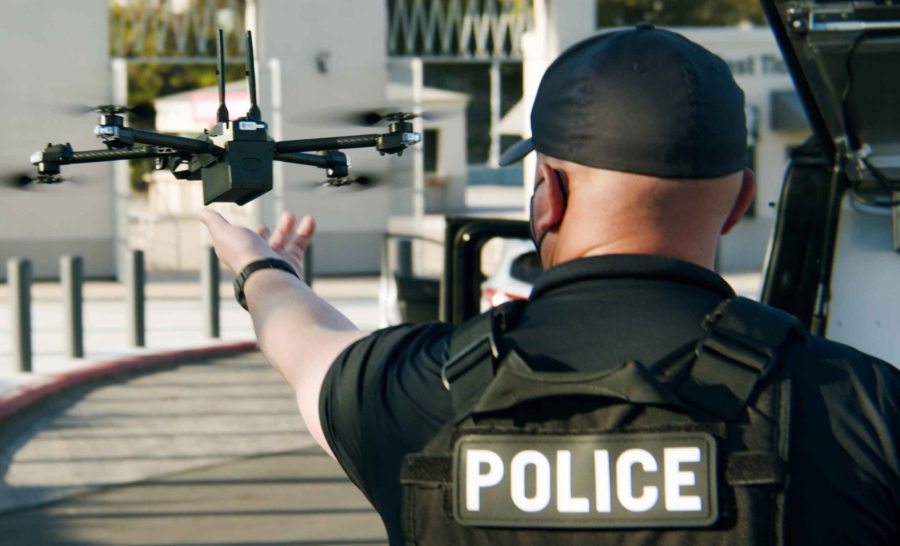
Credit: Skydio
1. Crime Scene Investigation
Police drones provide a valuable aerial perspective for crime scene investigations, allowing investigators to capture detailed images and videos from multiple angles.
High-resolution aerial footage can aid in reconstructing events, gathering evidence, and gaining insights that would be difficult to achieve from the ground alone. Drones can also help preserve the integrity of the crime scene while reducing the time and personnel required for documentation.
2. Search and Rescue Missions
In search and rescue operations, law enforcement drones are used to cover large areas quickly and access difficult or dangerous terrain.
Equipped with thermal imaging and night vision capabilities, drones can detect heat signatures and locate missing persons or victims in low-visibility conditions. These capabilities make drones invaluable for saving lives in situations where time is critical.
3. Surveillance and Crowd Monitoring
Cop drones are commonly deployed for surveillance purposes, especially during large events, protests, or public gatherings.
Drones can provide an overhead view, enabling officers to monitor crowd movement, detect potential threats, and maintain public order without requiring a large physical presence. They are also used in surveillance for ongoing investigations, allowing officers to observe suspects discreetly and reduce the need for ground-based observation teams.
4. Traffic Monitoring and Accident Investigation
Another practical use for drones in law enforcement is in traffic monitoring and accident investigation.
Drones can quickly assess accident scenes, gather footage, and help determine the causes of collisions. Additionally, drones can monitor traffic flow, identify congestion points, and support officers in managing traffic patterns more effectively, especially during peak hours or events that impact roadways.
5. Disaster Response and Assessment
Police drones can be instrumental in disaster response, providing rapid aerial assessments of affected areas during natural disasters or large-scale incidents.
Drones equipped with high-resolution cameras and sensors can identify damage, locate survivors, and assist rescue teams in prioritizing response efforts. This capability allows police departments to coordinate emergency responses efficiently.
6. Environmental Crime Monitoring
In cases of environmental crimes, such as illegal dumping, pollution, or unauthorized land use, drones can offer a quick and effective way to monitor affected areas.
Cop drones can capture detailed images and videos that document environmental damage, providing valuable evidence for enforcement actions and protecting natural resources.
7. Perimeter Security and Intrusion Detection
Police departments use drones to secure perimeters around sensitive areas or restricted zones, such as government facilities, large events, or crime scenes.
Equipped with high-resolution cameras and thermal sensors, drones can identify unauthorized intrusions and notify officers of potential security breaches, providing an extra layer of security and rapid response capabilities.
8. Suspect Tracking and Apprehension
Police drones can assist in tracking fleeing suspects by providing real-time aerial surveillance, even in challenging or obstructed environments.
Drones can follow suspects over long distances, reducing the need for high-speed chases and minimizing risks to the public. Real-time video feeds help officers plan safe and effective apprehension tactics.
9. Correctional Facility Surveillance
In correctional facilities, drones can monitor for contraband smuggling attempts, especially from outside the facility.
Law enforcement drones equipped with cameras can monitor the facility’s perimeter, preventing unauthorized deliveries and increasing overall security within and around the facility.
10. Training and Simulation
Police departments also use drones for training purposes.
By simulating real-life scenarios, drones allow trainees to practice search and rescue, suspect tracking, and other skills in controlled environments. Drone footage recorded during training exercises can be analyzed to improve tactics, procedures, and response times, creating a safer and more prepared law enforcement team.
Top 4 Benefits of Police UAVs
The integration of drones for police departments has brought significant advantages to law enforcement agencies, improving efficiency, reducing costs, and enhancing officer safety.
Here are the four main benefits law enforcement realizes from using UAVs in its work.

Credit: DJI
1. Cost Savings
Compared to traditional aerial solutions like helicopters, police drones offer a much more affordable alternative for aerial surveillance and data collection.
The lower purchase and maintenance costs allow even smaller police departments to incorporate drones into their operations. This cost-effectiveness enables departments to expand their capabilities without requiring a large budget.
2. Operational Efficiency
Drones for police use improve operational efficiency by reducing response times and streamlining workflows. Drones can be deployed quickly to survey areas, capture real-time data, and provide an immediate aerial view, allowing officers to assess situations before arriving on the ground. This efficiency is especially valuable in time-sensitive scenarios, such as search and rescue operations or crime scene investigations, where rapid access to information can make a critical difference.
3. Enhanced Situational Awareness
One of the primary advantages of drones in policing is the increased situational awareness they provide. Drones offer a comprehensive aerial perspective, allowing officers to monitor large areas, observe crowd dynamics, or assess hazards from a safe distance. This situational awareness enhances decision-making and enables law enforcement to respond proactively to potential threats or issues.
4. Improved Safety for Officers
Police drones also play a critical role in improving officer safety by reducing the need for officers to enter hazardous environments. Drones can be sent into dangerous areas—such as active crime scenes, natural disasters, or rough terrain—allowing officers to evaluate risks remotely. This capability minimizes exposure to danger and ensures that officers have the information they need to act safely and strategically.
The numerous advantages of police drones, from cost savings to enhanced safety, demonstrate their value in supporting law enforcement efforts. As technology advances, drones are set to play an even greater role in assisting police departments with efficient, safe, and cost-effective solutions for their daily operations.
Types of Drones Used by Police
Police departments employ various types of UAVs, each suited to specific tasks.
From versatile cop drones like quadcopters to long-range fixed-wing drones, each type provides unique capabilities that enhance the adaptability and effectiveness of law enforcement operations.
Here’s an overview of the main types of drones used by police.
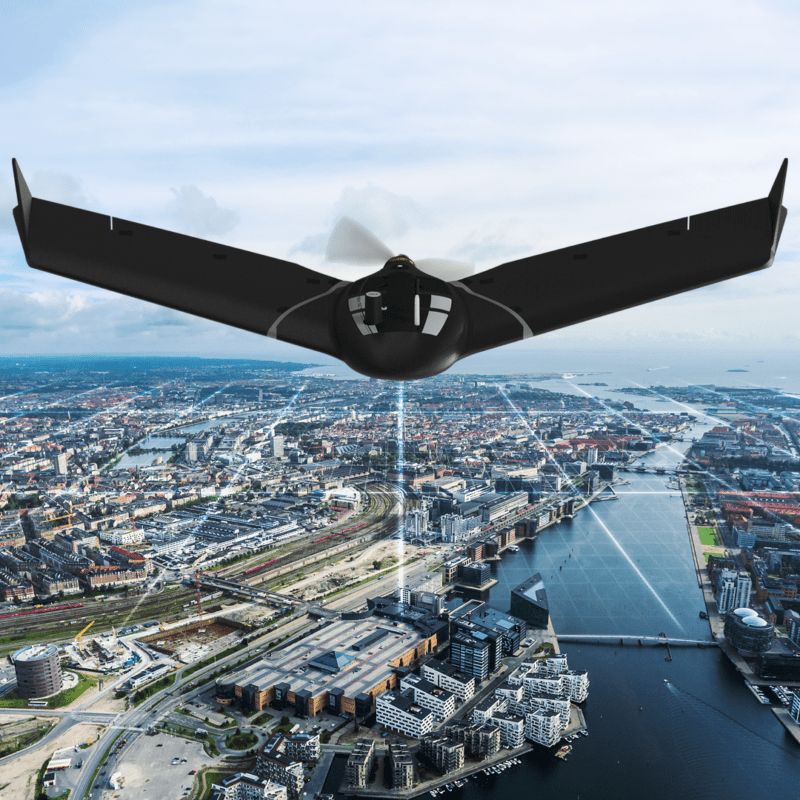
The eBee Tac Public Safety drone is a fixed wing UAV made for work in law enforcement
Quadcopters
Quadcopters are the most common type of police UAV, and the most common type of drone in general.
Quadcopters are popular among law enforcement for their agility, ease of use, and ability to hover steadily. They can take off and land vertically, making them practical in confined spaces, urban settings, and situations where rapid deployment is essential.
These drones are ideal for applications requiring stability, such as close-up surveillance, crowd monitoring, and accident scene documentation.
Fixed-Wing Drones
Fixed-wing drones differ from quadcopters in that they have a single wing, like an airplane, allowing them to glide efficiently over long distances.
These drones are used for police drone operations requiring extensive coverage, such as monitoring large events, border patrol, or search and rescue in remote areas. While fixed-wing drones cannot hover, their extended flight time and range make them invaluable for missions that require sustained aerial surveillance.
Hybrid Drones
Hybrid drones combine features of both quadcopters and fixed-wing drones, offering the ability to take off and land vertically while also covering long distances efficiently. This versatility makes them suitable for complex missions where a combination of range, stability, and rapid deployment is needed, such as search and rescue operations that require quick response and extended flight time.
Specialized UAVs
Certain police missions require specialized UAVs equipped with advanced technologies like thermal imaging, high-definition zoom cameras, or LiDAR sensors.
These cop drones are customized for specific purposes, such as night surveillance, accident reconstruction, and locating individuals in low-visibility conditions. By using drones tailored to the needs of specialized tasks, police departments can gather detailed information that would be difficult or unsafe to collect manually.
Case Studies: 5 Real-Life Cop Drone Stories
The use of drones for police use has proven invaluable in a variety of real-life scenarios, from locating missing persons to monitoring large public gatherings.
Here are 5 short case studies illustrating drones support law enforcement work.
1. Search and Rescue Operations
In 2019, the Chula Vista Police Department (CVPD) in California used drones to help find a missing elderly man with dementia. Equipped with a thermal camera, the police drone enabled officers to spot the man in a ravine, saving critical time in an urgent situation.
2. Crime Scene Analysis
In 2020, police in Lincolnshire, UK, deployed a drone to capture aerial images of a large crime scene involving a homicide. The police UAV allowed investigators to map the area efficiently, preserving the scene’s integrity while documenting critical evidence from above.
3. Public Event Monitoring and Crowd Control
During the 2017 Super Bowl in Houston, Texas, drones were deployed by police to provide aerial views of the stadium and surrounding areas, ensuring security and rapid response to any incidents. These drones enabled enhanced situational awareness for law enforcement, helping it manage one of the nation’s most high-profile events.
4. Traffic Accident Investigation
In 2018, the Kansas Highway Patrol implemented drones for accident investigations. According to a case study by the Kansas Highway Patrol, drones reduced the time needed to map accident scenes from hours to just 20 minutes, allowing roads to reopen faster and minimizing disruption to traffic.
5. Disaster Response and Recovery
After Hurricane Michael in 2018, police departments in Florida used drones to assess damage, locate survivors, and direct rescue efforts. The use of police drones allowed teams to quickly gather critical information, enhancing response coordination and efficiency.
5 Key Features for Choosing a Police Drone
Law enforcement drones are equipped with cutting-edge technology and features that make them powerful tools in policing.
Here are five key features that make drones for police use indispensable in modern law enforcement.
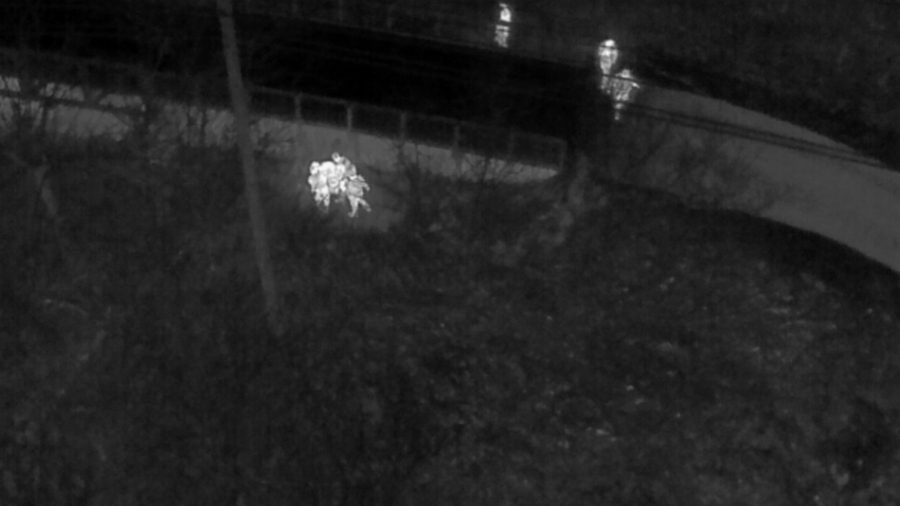
A thermal drone image of a theft suspect
1. Thermal Imaging
Thermal imaging is one of the most valuable features for law enforcement drones. By detecting heat signatures, thermal cameras allow officers to locate individuals or objects in low-visibility conditions, such as at night or in densely wooded areas. This capability is crucial in search and rescue operations, suspect tracking, and disaster response, enabling law enforcement to locate people quickly and efficiently.
2. High-Definition Cameras
Many police drones are equipped with high-definition (HD) cameras that capture detailed images and video footage. These cameras support real-time surveillance, provide clear evidence for investigations, and allow officers to observe situations from a safe distance. High-resolution footage also helps in documenting crime scenes and accident sites, preserving details that might be missed from the ground.
3. GPS and Navigation Systems
GPS and advanced navigation systems allow drones for police use to operate with precision, even in complex environments. GPS tracking ensures accurate positioning, helps drones follow predefined flight paths, and allows officers to monitor the drone’s location in real-time. This accuracy is particularly useful in monitoring large areas, patrolling borders, or mapping crime scenes for investigative purposes.
4. Real-Time Data Transmission
Real-time data transmission enables law enforcement drones to send live video and data feeds directly to officers on the ground. This feature provides immediate situational awareness, allowing command centers and field officers to make rapid, informed decisions. During emergencies or high-stakes incidents, real-time streaming is critical for coordinated responses and assessing on-the-ground conditions as events unfold.
5. Obstacle Avoidance Systems
Equipped with obstacle avoidance systems, many police drones can detect and maneuver around obstacles autonomously. This technology improves safety and stability during flights, allowing drones to navigate complex terrains or urban environments where buildings, trees, or other obstructions are present. Obstacle avoidance ensures that drones can complete missions with minimal risk, even in challenging conditions.
With these advanced features, drones for police use provide valuable support for various law enforcement operations. From enhancing visibility with thermal imaging to enabling strategic decision-making through real-time data transmission, these technologies make police drones versatile tools that empower officers to perform their duties more effectively and safely.
Future of Drones in Law Enforcement: 5 Trends and Innovations
The future of drones in policing is rapidly evolving, driven by emerging technologies that promise to expand the role of drones in law enforcement.
Innovations such as AI-powered drones, autonomous flight capabilities, and seamless integration with other police technologies are transforming drones for police departments into even more versatile and powerful tools.
Here are some of the key trends and advancements shaping the future of police drones.
1. AI-Powered Drones
Artificial intelligence (AI) is paving the way for smarter and more capable police drones. AI-powered drones for police use can process data in real-time, recognize objects, and even identify faces or license plates. This capability allows drones to autonomously track suspects, analyze suspicious behaviors, and respond to complex situations without continuous human control. As AI technology continues to advance, drones will be able to perform more sophisticated tasks, further enhancing police efficiency and effectiveness.
2. Autonomous Flight Capabilities
Autonomous flight technology enables drones to navigate and carry out missions with minimal operator input. In the future, police drones will be able to autonomously patrol designated areas, respond to emergencies, or monitor crime-prone locations in real-time. This will be particularly beneficial in situations where rapid response is critical, such as active shooter incidents or missing persons cases, allowing drones in policing to provide crucial support faster than ever before.
3. Integration with Other Law Enforcement Technologies
The integration of drones with other police systems, such as surveillance networks, body cameras, and data analytics platforms, is another promising trend. By connecting drones for police departments with existing technologies, departments can streamline data collection and improve situational awareness. For instance, footage from police drones can be synced with ground-based surveillance feeds, enabling command centers to get a comprehensive view of incidents and enhance coordinated responses.
4. 5G Connectivity and Real-Time Data Transfer
The rollout of 5G networks is expected to boost drone capabilities by providing faster, more reliable data transfer. With 5G connectivity, drones can transmit high-definition video and real-time data with minimal latency, making it possible for officers to receive instantaneous updates from the drone. This connectivity will improve situational awareness, especially in dynamic situations where officers need real-time information to make critical decisions.
5. The Rise of Drone as First Responder (DFR) Programs
Drone as First Responder (DFR) programs are rapidly gaining traction within police departments, offering an innovative approach to emergency response and public safety. In a DFR program, drones are deployed as the initial responders to incidents, arriving on scene often before ground units. Equipped with live-streaming capabilities, these drones provide real-time visual information to officers and dispatch centers, allowing them to assess the situation remotely, plan responses, and deploy resources more effectively.
The presence of DFR programs in police departments can improve response times, especially in time-sensitive situations like burglaries, car accidents, or disturbances. As DFR technology evolves, police departments are increasingly able to deploy drones autonomously to designated areas, significantly enhancing situational awareness and operational efficiency while minimizing risks to officers and the public.

The Chula Vista Police Department launched the first ever DFR program in 2018
6. Expanded Roles and Use Cases
As technology advances, the range of applications for police drones is set to expand. Beyond traditional tasks like surveillance and search and rescue, future drones for police use could play roles in traffic monitoring, crowd control, environmental assessments, and even disaster response. Drones may also become valuable tools for predictive policing, using data analytics to monitor patterns and preemptively address potential incidents.
Police UAV FAQ
How do the police use drones in their work?
Police use drones for a variety of purposes, including surveillance, search and rescue, crime scene analysis, traffic monitoring, and crowd control. Drones provide an aerial perspective that enhances situational awareness and allows officers to respond to incidents more effectively.
What are the legal requirements for police in their use of drones?
Police departments must adhere to federal and local regulations, which may include obtaining warrants for surveillance or following specific privacy guidelines. In the U.S., the FAA governs airspace, and some states have additional restrictions on police drone usage to ensure privacy rights are respected.
What is a DFR program?
A DFR (Drone as First Responder) program allows police drones to be deployed quickly to incident locations, often arriving before officers on the ground. This capability provides valuable real-time information to responders, improving response times and situational awareness.
What kinds of drones are used by the police?
Police use a variety of drones, including quadcopters for stability, fixed-wing drones for long-range operations, and hybrid drones for versatility. Specialized drones equipped with thermal imaging and high-definition cameras are also common for enhanced surveillance and search and rescue.
Do police drones have cameras?
Yes, most police drones are equipped with high-definition cameras for real-time surveillance and recording. Some also have advanced features like thermal imaging, night vision, and zoom capabilities to aid in specific operations.
Are police drones allowed to record footage over private property?
Recording over private property is subject to legal restrictions, often requiring warrants or adherence to privacy laws. Police departments must balance the need for surveillance with privacy rights, ensuring that drone usage complies with local and federal guidelines.
How do police drones help in search and rescue missions?
In search and rescue missions, police drones can cover large areas quickly, even in challenging or dangerous terrain. Thermal imaging cameras help locate individuals by detecting heat signatures, making drones especially useful in low-visibility conditions.
What are the benefits of using drones in police work?
Police drones provide real-time data, enhance situational awareness, reduce costs compared to helicopters, and improve safety by allowing officers to assess situations from a distance. They enable faster response times and efficient resource management in critical operations.
Can drones replace helicopters in police work?
While drones offer many advantages, they are not a complete replacement for helicopters. Drones are ideal for shorter missions and lower-altitude work, whereas helicopters are better suited for longer-range, high-altitude operations. Drones often complement helicopters rather than replace them.
What are the challenges of using drones in policing?
Challenges include privacy concerns, regulatory restrictions, and technical limitations like limited battery life and range. Additionally, public perception of surveillance can create resistance, making it important for departments to use drones transparently and ethically.