What Federal Law Says: Is It Legal to Fly a Drone Over Private Property?
According to federal law it is legal to fly a drone over private property.
As we noted above, the Federal Aviation Administration (FAA) oversees airspace regulations for drones.
According to the FAA, you may fly a drone over private property as long as these rules are followed:
- Drones must be flown below 400 feet altitude
- You must keep the drone within visual line of sight
- You must register any drone weighing over 0.55 pounds with the FAA
- If you’re flying commercially (i.e., for work) you need to obtain an FAA Part 107 certificate (also called a drone license)
- You can’t fly over people or cars
State and Local Laws May Still Be a Concern
However, there is some nuance here.
You can’t fly over someone’s property to spy on them, and several states have privacy laws that put drone ops over private property in murky territory from a legal perspective—even though, again, it’s legal to fly over private property according to the FAA.
Sound like a contradiction? That’s because it is.
While states are not legally allowed to make laws about what happens in the national airspace—because, again, the FAA is in charge of the national airspace and has what is called preemption, giving them the primary authority to make rules about operations in that airspace—states, municipalities, and other local authorities still do make such laws. And the only way to get these laws overturned is to go to court.
Of course, this makes for a complicated landscape when it comes to flying your drone over private property.
Big picture, the FAA says you can fly a drone over private property. But it’s a good idea to be aware of local laws where you live that may limit certain types of flying over private properties, so that you can make an informed choice about how you choose to fly.
[Need help with the FAA’s Part 107 test? We’ve trained over 70,000 drone pilots + our students have a 99%+ pass rate. Learn how we can help you get ready now.]
State Laws Related to Flying a Drone Over Private Property
As we just covered, some states and other local governments have created laws that impact drone operations, often without the proper legal authority to do so.
Nonetheless, you may still get fined or even jailed for breaking these laws. That’s because, until someone takes the creator of the law to court and has it formally challenged—and wins—the law still stands as enforceable.
[Related read: CUAS Explained—How It Works and What’s Legal in the U.S.]
So it’s a good idea to be aware of the local laws in your area when navigating whether you can fly a drone over private property.
Here’s an overview of state laws related to the question, Can you fly a drone over private property?
| State/Province | Regulations | Source Link |
|---|---|---|
| California | AB 856 prohibits drone use to invade privacy. | AB 856 |
| Florida | SB 766 bans capturing images of private property without consent when privacy is expected. | SB 766 |
| Indiana | HB 1009 makes electronic surveillance of private property without consent a misdemeanor. | HB 1009 |
| Michigan | SB 992 prohibits drone use for harassment, violating restraining orders, or invading privacy. | SB 992 |
| North Carolina | NC Gen. Stat. § 15A-300.1 restricts drone flights over private property without consent. | NC Gen. Stat. § 15A-300.1 |
| Ohio | Rule 3341-6-50 requires avoiding privacy violations when recording images with drones. | Rule 3341-6-50 |
| Oklahoma | HB 3171 prohibits drones from trespassing or conducting surveillance over private property. | HB 3171 |
| Pennsylvania | Title 18 Sec. 3505 bans drones used for surveillance, causing fear, or delivering contraband. | Title 18 Sec. 3505 |
| South Carolina | SB 498 prohibits drones with cameras from flying over private property without consent. | SB 498 |
| Tennessee | SB 1892 makes intentional surveillance of a person or property using drones a misdemeanor. | SB 1892 |
| Texas | HB 912 forbids capturing or distributing images of people or property without consent. | HB 912 |
| Virginia | Flying a drone within 50 feet of a dwelling without consent is a misdemeanor. | 4VAC15 |
| Washington | WAC 172-110-070 bans drones in places with a reasonable expectation of privacy. | WAC 172-110-070 |
| Wisconsin | Chapter 942.10 prohibits using drones to observe individuals in private settings. | 942.10 |
Want to learn more about local drone laws? Check out our directory of drone laws by state.
Best Practices for Flying a Drone Over or Near Private Property
When flying drones near residential or private areas, operators should follow best practices to ensure responsible and legal operation.
Here are some guidelines to consider:
- Do your airspace research. Use tools like the FAA’s B4UFLY app to avoid restricted airspace.
- Follow the FAA’s rules. Make sure you understand the FAA’s rules and follow them when you’re flying.
- Fly in a way that avoids privacy concerns. To avoid any sense that you may be spying, try not to fly low or hover near windows or backyards.
- Make your presence known. Set up a cone, place your launch pad in a prominent location, wear a vest, wear your Part 107 certificate around your neck, and take other steps to make it clear that you are flying for a reason and not try to hide the fact that you’re flying. Doing this can help you avoid any sense that you’re trying to spy or invade people’s privacy.
- Be professional. If you’re flying for work, take all the steps above as well as considering informing any homeowner whose property you may fly over or near about your operations. There have been incidents of people shooting at drones recently, and taking these preemptive steps could help you avoid that kind of hostile encounter.
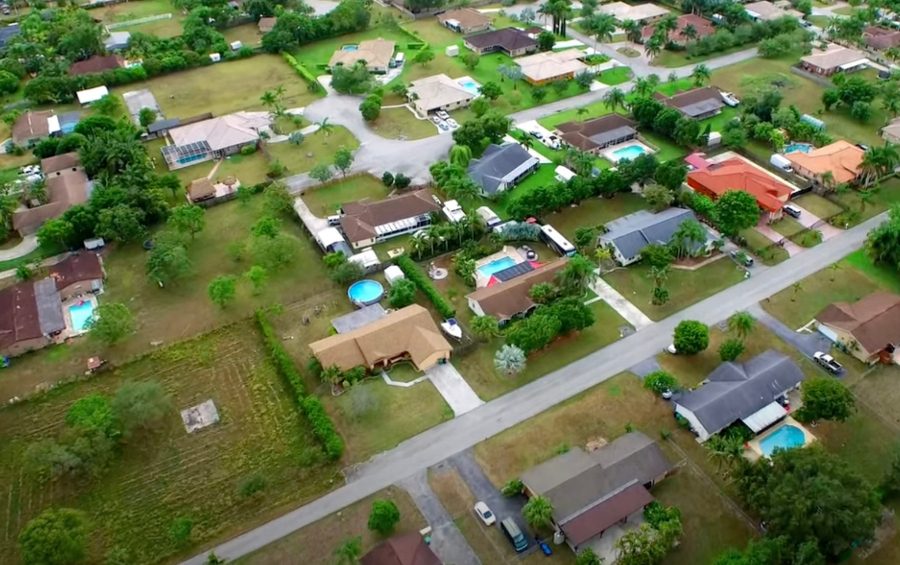
Drone shot of a neighborhood
Related Resources
Want to learn more about drones and flying over private property?
Here are some related resources:
- Can a Property Owner Tell Me Not to Fly Over His or Her Property?
- Can I Fly a Drone in a Public Park?
- How to Fly a Drone: Everything You Need to Know to Get Started
- Drone Shot Down: What to Do If Someone Shoots Your Drone
Drones Over Private Property FAQ
Here are some of the most commonly asked questions related to whether you can fly a drone over private property.
Can you fly a drone over private property?
In general, flying a drone over private property is allowed in public airspace, but flying too low or invading privacy may be restricted by local laws. Operators should check both federal and state regulations.
Can I fly a drone in my neighborhood?
Yes, but it is important to follow local regulations, respect neighbors’ privacy, and avoid causing disturbances. Some areas may have specific rules regarding drone usage.
How low can you fly a drone over private property?
The acceptable altitude for flying over private property can vary, but it is generally recommended to stay above 83 feet to avoid legal disputes. Regulations differ by region, so check local laws.
Is it illegal to fly a drone over private property?
Flying over private property is not inherently illegal, but it can be considered trespassing or an invasion of privacy at low altitudes or if capturing footage without consent. Always follow local privacy laws.
Do drone laws vary by state when flying over private property?
Yes, some states impose additional restrictions or privacy protections beyond federal regulations. Operators should research state-specific drone laws before flying.
What should I do if a drone is flying over my property?
If a drone is flying over your property without permission, you can contact the drone operator or local authorities. You may also report the incident to aviation regulators if you believe your privacy is being violated.
Are there specific laws for drones near residential areas?
Some regions have rules that restrict drone flights near residential areas to protect privacy and reduce disturbances. Check local ordinances or homeowners’ association regulations.
Can drones record footage over private property?
Recording footage over private property may be subject to privacy laws. Operators should avoid capturing images or videos where individuals have a reasonable expectation of privacy, such as through windows or fenced yards.
Do different countries have varying drone laws?
Yes, drone regulations differ significantly worldwide. For example, Europe has stricter privacy rules under GDPR, while the U.S. follows FAA guidelines with additional state regulations. It’s important to adapt to local laws when traveling.
How can I legally fly a drone near private property?
To fly a drone legally near private property, stay within public airspace, avoid low-altitude flights, and respect privacy. Obtain permissions if necessary and use tools like GPS geo-fencing to avoid restricted areas.